Table of Contents


After the earthquake: How the assassination of Charlie Kirk is reshaping campus speech nationwide

Executive summary
The aftershocks of Charlie Kirk鈥檚 assassination, in front of thousands of students at Utah Valley University, have reverberated across the country and acutely impacted campuses nationwide. To understand how the assassination is shaping student attitudes and behavior, 蜜桃直播 commissioned College Pulse to conduct a nationwide survey of 2,028 undergraduates, including an oversample of 204 students at UVU.
The survey was fielded between Oct. 3 and Oct. 31, 2025, and has a margin of error of +/- 2.2%.
Key findings include:
- Half of students surveyed say that they are less comfortable attending or hosting controversial public events on their campus.
- A notable portion of students is also less comfortable expressing their views on controversial topics in class (45%), in common campus spaces (43%), and on social media (48%), after what happened to Charlie Kirk.
- And roughly one in five students say they are now less comfortable attending class.
- These feelings were most pronounced among students at Utah Valley University, and among moderate and conservative students nationwide.
- Compared to this past spring, moderate and conservative students are less accepting of other students using aggressive or violent protest tactics. Liberal students, in contrast, did not shift their views in the same way.
- A majority of students opposed allowing all six controversial speakers on campus they were asked about.
- In contrast, a majority of students opposed firing all four professors from their campus for hypothetical social media comments made following Kirk鈥檚 assassination.
- A majority of students (53%) say that political violence is a problem among all groups, considerably more than the 35% of Americans who recently said this in FIRE鈥檚 October National Speech Index.
Overview
The assassination of Charlie Kirk at Utah Valley University marked a jarring escalation in America鈥檚 already volatile political climate. This wasn鈥檛 just an attack on a high-profile public figure 鈥� it tore at the very fabric of our sense of community as a people. A staunch free-speech advocate but also a polarizing presence on college campuses, Kirk was assassinated while doing what he often did: engaging in open political debate.[1]
His killing sent shockwaves through higher education and the broader national discourse, prompting urgent conversations about free speech, political violence, and personal safety in public life.[2] And it has fueled concerns that political violence is no longer a fringe threat, but a force capable of reshaping the culture of speech and dissent. The effects of this assassination have already reverberated across the country.
In the weeks following Kirk鈥檚 assassination on Sept. 10:
- Matthew Dowd, a political commentator, was fired from MSNBC for comments he made to Katy Tur about the assassination.[3] He was also disinvited from speaking at the Hefner-Martin Endowed Lecture Series at Cumberland University.[4]
- A vigil honoring Kirk at Kennesaw State University was repeatedly disrupted by protesters who attempted to drown out the speakers by chanting and banging drums outside the venue. Protestors also damaged fencing around the venue and directly confronted attendees.[5]
- FIRE documented 80 campaigns to sanction scholars 鈥� 40 of which resulted in penalties, including 18 terminations. Many of these cancellation campaigns were led by prominent conservative influencers on social media and/or by elected officials at the state and federal levels.[6]
- FIRE has also recorded 25 campaigns targeting individual students or student groups for speech regarding Kirk and/or his assassination, and an additional five against campus chapters of Turning Point USA, the organization Kirk founded.[7]
To understand how the assassination is shaping student attitudes and behavior, 蜜桃直播 commissioned College Pulse to conduct a nationwide survey of 2,028 undergraduates, including an oversample of 204 students at UVU. The survey was fielded between Oct. 3 and Oct. 31, 2025.
The goal was simple: to assess whether the assassination and reactions to it are having a chilling effect on campus. We asked students whether recent events had affected how comfortable they were to speak freely, to organize events or attend campus events, and to attend class. We also asked them if professors should be fired for hypothetical comments they made on social media about Kirk after his assassination, and included measures of political tolerance for controversial speakers and student views on the acceptability of disruptive protest from our College Free Speech Rankings survey.
What we found is troubling.
The results paint a complex picture. In many ways, the assassination appears to have deepened existing fractures. Students report feeling less comfortable expressing themselves, especially those who are politically conservative.
A notable portion of students nationwide report being less comfortable expressing political views in the classroom, in a common campus space like the quad or lounge, or on social media; they say the same thing about attending public events on campus; and even about attending class. Concern is significantly more pronounced among students at UVU, and among politically conservative students nationwide. But students who do not identify with Kirk鈥檚 politics also report pulling back from public expression, suggesting that the effects of this political violence cross ideological lines.
This report first presents the findings from Utah Valley University, since it was the site of Kirk鈥檚 assassination. These analyses reveal that while the assassination has negatively impacted UVU students鈥� comfort expressing their views, engaging politically on campus, and attending class, it also finds encouraging signs. For instance, UVU students, compared to students on other campuses nationwide, show increased tolerance and report more relative trust in institutional protections for free speech. The report then delves into how Kirk鈥檚 assassination impacted students on those other campuses across the country.
The epicenter: Utah Valley University
Just a few months ago, Utah Valley University was widely regarded as one of the safest campuses in the country, and its president said, 鈥淭his is not a highly politicized place.鈥�[8] In this year鈥檚 College Free Speech Rankings, UVU was ranked first overall on 鈥淒isruptive Conduct,鈥� meaning the students there are least likely to say that students shouting down a speaker, blocking entry to an event, or using violence to stop a speech are ever acceptable, and 41 on 鈥淎dministrative Support.鈥�[9]
Then came Sept. 10, 2025. Thousands of students attended Kirk鈥檚 campus event and witnessed his assassination. Those not in attendance sheltered in place as law enforcement secured the scene.[10]
To its credit, UVU responded quickly. Classes were canceled for the remainder of the week and counseling services were expanded. New student organizations promoting tolerance have popped up, and the university plans to launch a civic dialogue program.[11]
Anecdotally, the atmosphere appears calm. But the survey data tell a more complicated story.
Compared to their peers nationwide, UVU students report a deeper sense of pessimism about the state of free expression in the United States 鈥� 86% say it is heading in the wrong direction. This is significantly higher than the 74% of non-UVU students surveyed, and the 74% of Americans who also say this in 蜜桃直播鈥檚 October National Speech Index.[12] On their own campus, 55% of UVU students say things are heading in the wrong direction, compared to 46% of students elsewhere.
UVU students also report being more affected by the assassination in their day-to-day expression 鈥� they are more likely than students at other institutions to say they feel 鈥渁 great deal鈥� or 鈥渟lightly鈥� less comfortable:
- Expressing controversial views in class, on social media, or in public campus spaces;
- Attending or hosting controversial events;
- Participating in any public event;
- And even attending class on campus.
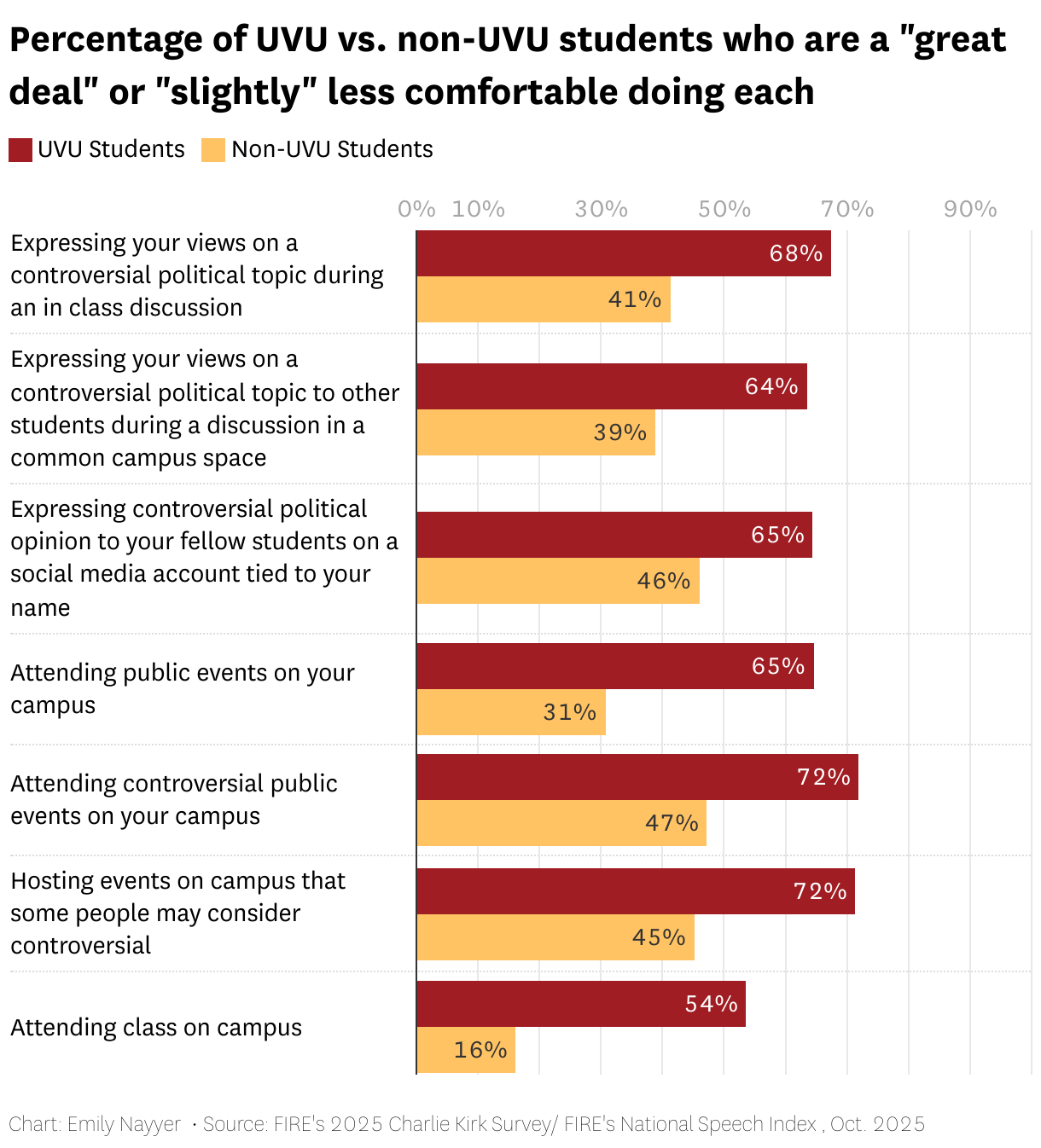
Self-censorship during classroom discussions has also increased. Before the Kirk assassination, roughly one in four students at UVU (24%) surveyed for 蜜桃直播鈥檚 annual College Free Speech Rankings say they self-censored in this context at least a couple of times a week. Now, one-third of UVU students say this.
These results show that witnessing political violence firsthand has had measurable effects.
Yet despite heightened fear and uncertainty following the assassination, the data from UVU also reveals signs of increased tolerance, and even relative trust in institutional protections for free speech.
When asked how often people who express offensive opinions should face consequences, 21% of UVU students say 鈥渘ever,鈥� nearly three times the rate of students at other schools (8%).
UVU students are also significantly more likely to say that students shouting down a speaker, blocking other students from entering an event, or using violence to stop a campus speech are never acceptable, compared to their peers on other campuses.
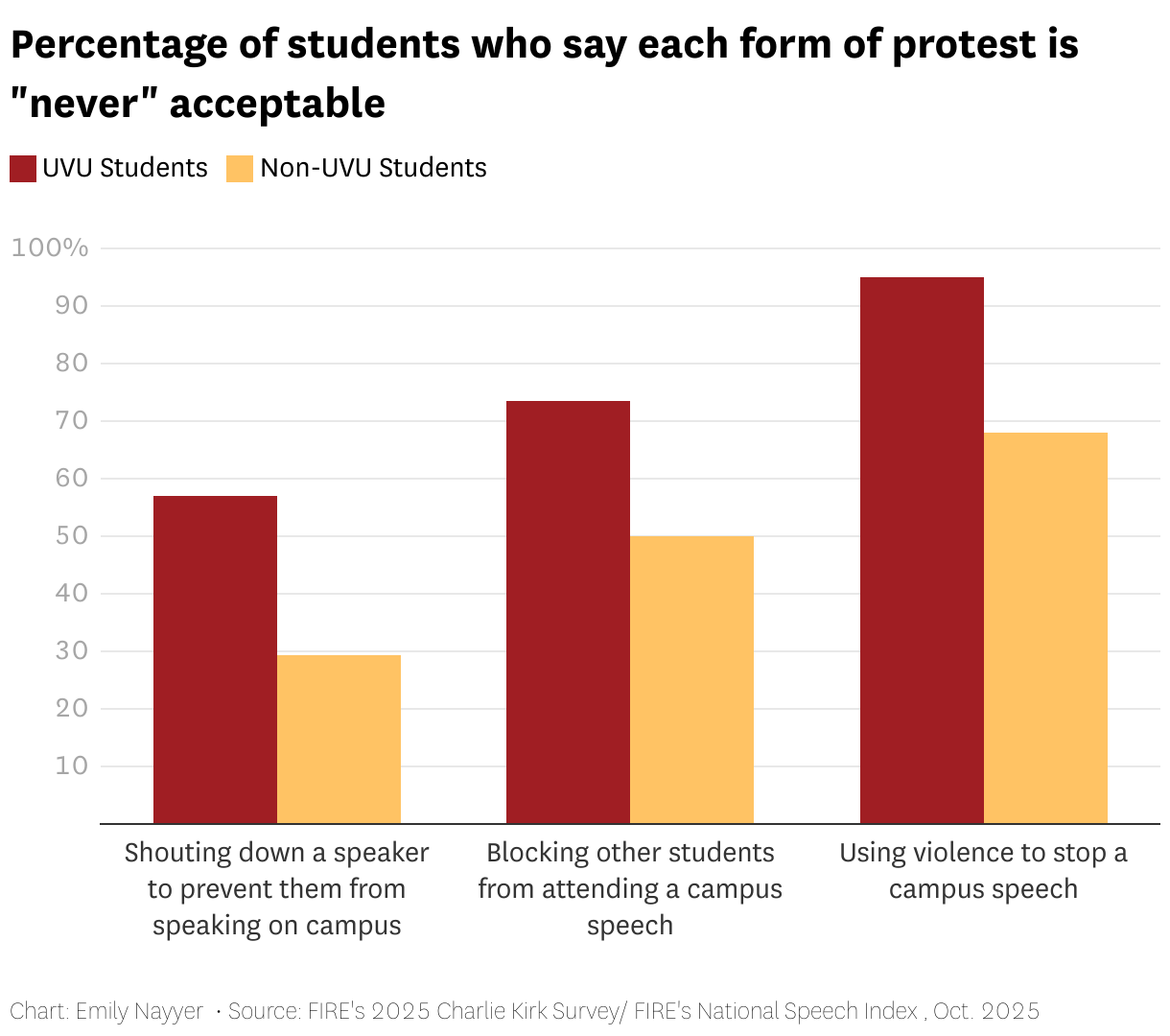
These same questions were posed to UVU students this past spring for the 2026 College Free Speech Rankings.[13] Prior to Kirk鈥檚 assassination on campus:
- 47% said shouting down a speaker was 鈥渘ever鈥� acceptable, 54% now say this.
- 67% said blocking other students from attending a campus speech was 鈥渘ever鈥� acceptable, 74% now say this.
- And 81% said using violence to stop a campus speech was 鈥渘ever鈥� acceptable, 94% now say this.
This pattern of increased tolerance is echoed in students鈥� confidence in university leadership to protect freedom of speech. UVU students are also more likely than their peers on other campuses to say that their college would never punish students for a range of provocative or controversial statements, including:
- 鈥淏igots who say hateful things deserve to be shot.鈥�
- 鈥淕un nuts worship their AR-15s more than they value human lives.鈥�
- 鈥淚llegal immigrants should be arrested and deported.鈥�
- 鈥淒ebate me, prove me wrong.鈥�
- 鈥淚f a trans-identified male is in a female-only space, he is committing a violent abusive act.鈥�
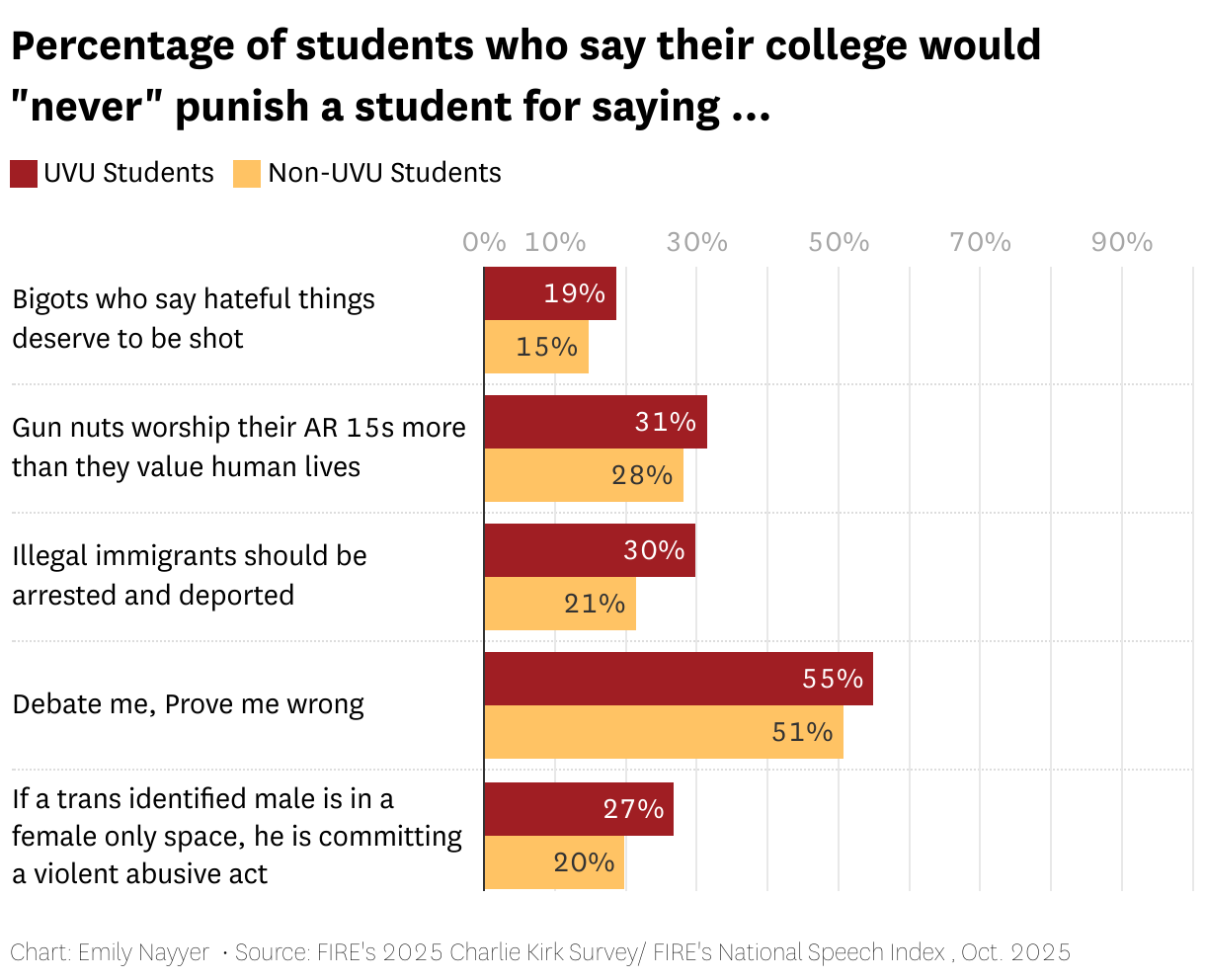
Furthermore, 33% of UVU students say they have either 鈥渜uite a lot鈥� or 鈥渇ull鈥� confidence that their administration will protect their First Amendment rights, compared to just 26% of students on other campuses. And only 14% of UVU students report having 鈥渘o鈥� or 鈥渧ery little鈥� confidence in their administration鈥檚 support for free speech, half the rate seen elsewhere (28%).
These results show that, even in the wake of a traumatic event, UVU students have more trust and confidence in their school鈥檚 administration to protect their expression than their peers on other campuses.
Nationwide aftershocks and reverberations
While Utah Valley University presents a unique case, as the site of Kirk鈥檚 assassination and a campus with relatively high trust in its administration to protect First Amendment rights,[14] the survey responses from students at other institutions reveal widespread discomfort with political expression in the wake of the Kirk assassination. Students nationwide now report feeling less comfortable expressing controversial views, hosting or attending public events, and engaging in open discussion, both online and in person, than before the assassination.
This section explores how students across the country are reacting to the assassination, how they understand the relationship between speech and violence, and how their views on protest, punishment, and political violence have changed since this spring鈥檚 College Free Speech Rankings survey.[15] It also connects these findings with broader data from 蜜桃直播鈥檚 National Speech Index, comparing college undergraduates to members of the general public.[16]
Although UVU students were more likely to report feeling less comfortable expressing themselves, attending or hosting campus events, or even going to class, students at other institutions also reported significant discomfort. This chilling effect is especially pronounced among conservative students, who consistently report higher levels of unease than their moderate and liberal peers.
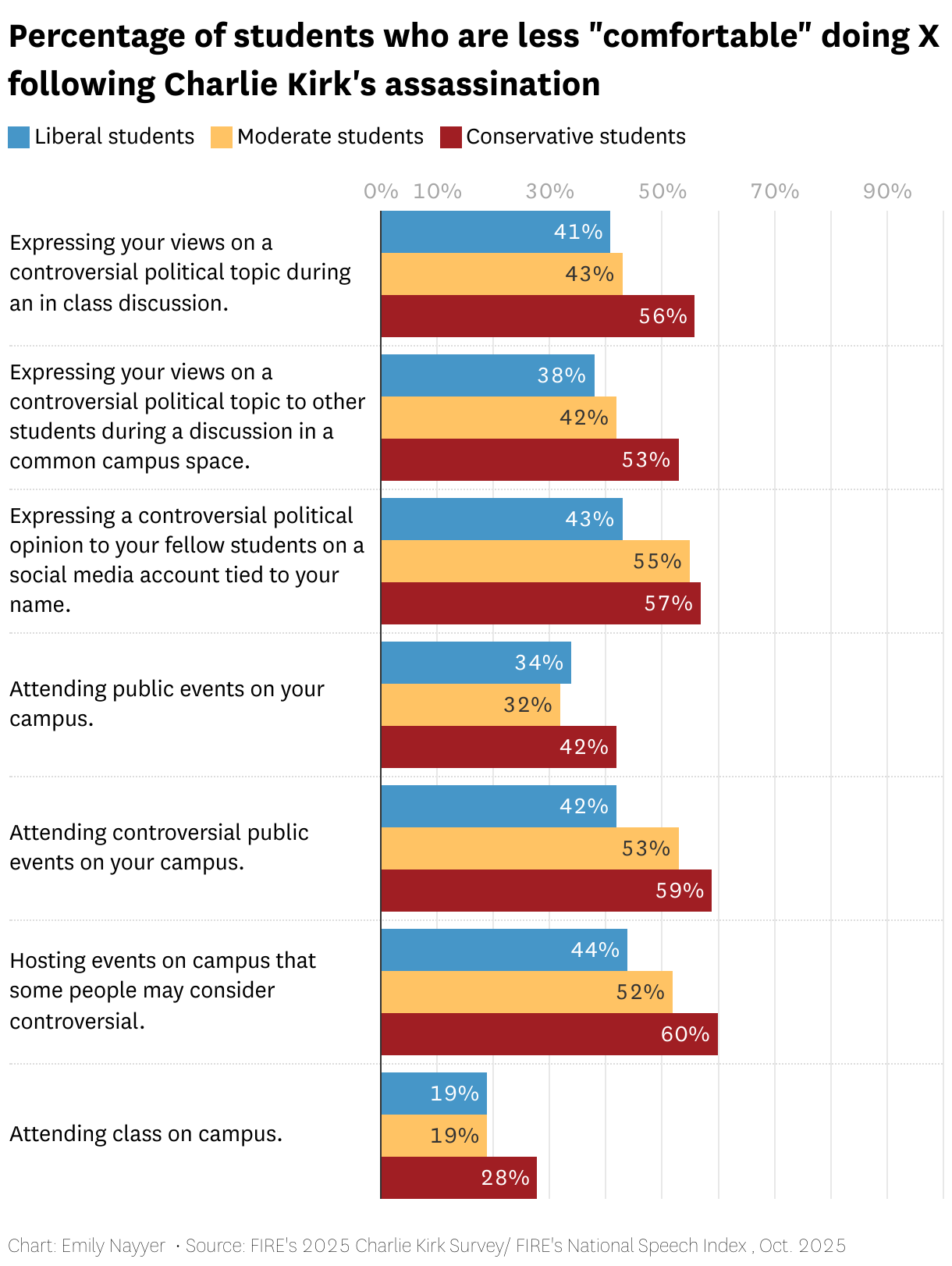
Yet the assassination appears to have had little effect on student views about shouting down or using violence to stop campus speakers. This past spring, 72% of non-UVU students said that shoutdowns were acceptable to some degree; today, that figure stands at 71%. The numbers are similarly stable regarding violence: 34% previously said it was acceptable to use violence to stop a campus speech, compared to 32% now.[17]
However, there was a modest shift on one front: support for blocking other students from entering an event declined from 54% to 50%.[18]
This contrasts starkly with how UVU students seemed to respond to the assassination, and may have occurred because UVU was one of the more conservative student bodies among the schools included in this year鈥檚 College Free Speech Rankings.[19]
In the current survey, 31% of the UVU students sampled identify as conservative, compared to 17% of students on other campuses. And among the non-UVU students, there is a clear ideological divide in how they responded to the assassination of Kirk when it comes to the acceptability of disruptive or violent protest tactics on campus.
Moderate and conservative students became significantly less likely to say that shouting down a speaker, blocking entry to an event, or using violence to stop a campus speech are acceptable actions. In contrast, liberal students鈥� support for these tactics held steady, or even increased slightly.
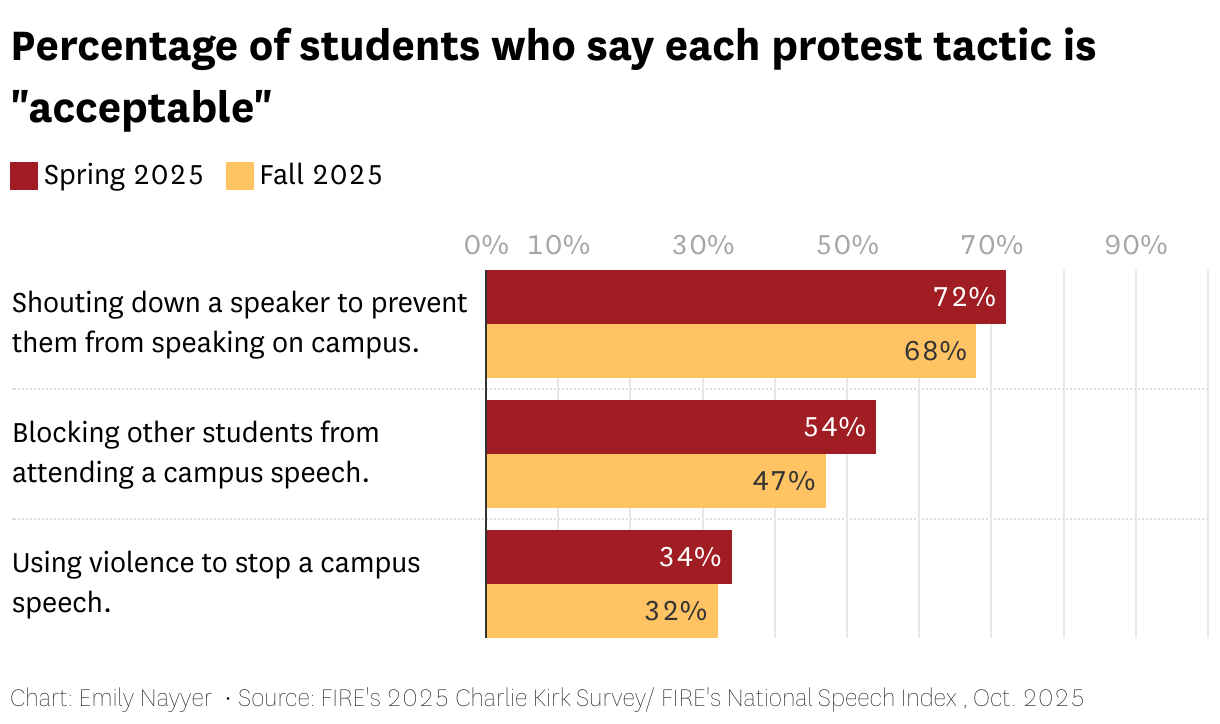
These divergent patterns show that the assassination may have caused moderate and conservative students to grow more wary of aggressive or violent protest tactics, perhaps reflecting increased concern about the real-world consequences of political violence. Liberal students, in contrast, showed no similar pullback, indicating that the event did not shift their views in the same way.
The findings are similar when it comes to whether controversial speakers should be allowed on campus or not.
The assassination has had a chilling effect 鈥� not just at UVU, but across the country. Students say they are pulling back, are speaking less, and are less comfortable attending events. This is not being done in response to policy, but because of fear.
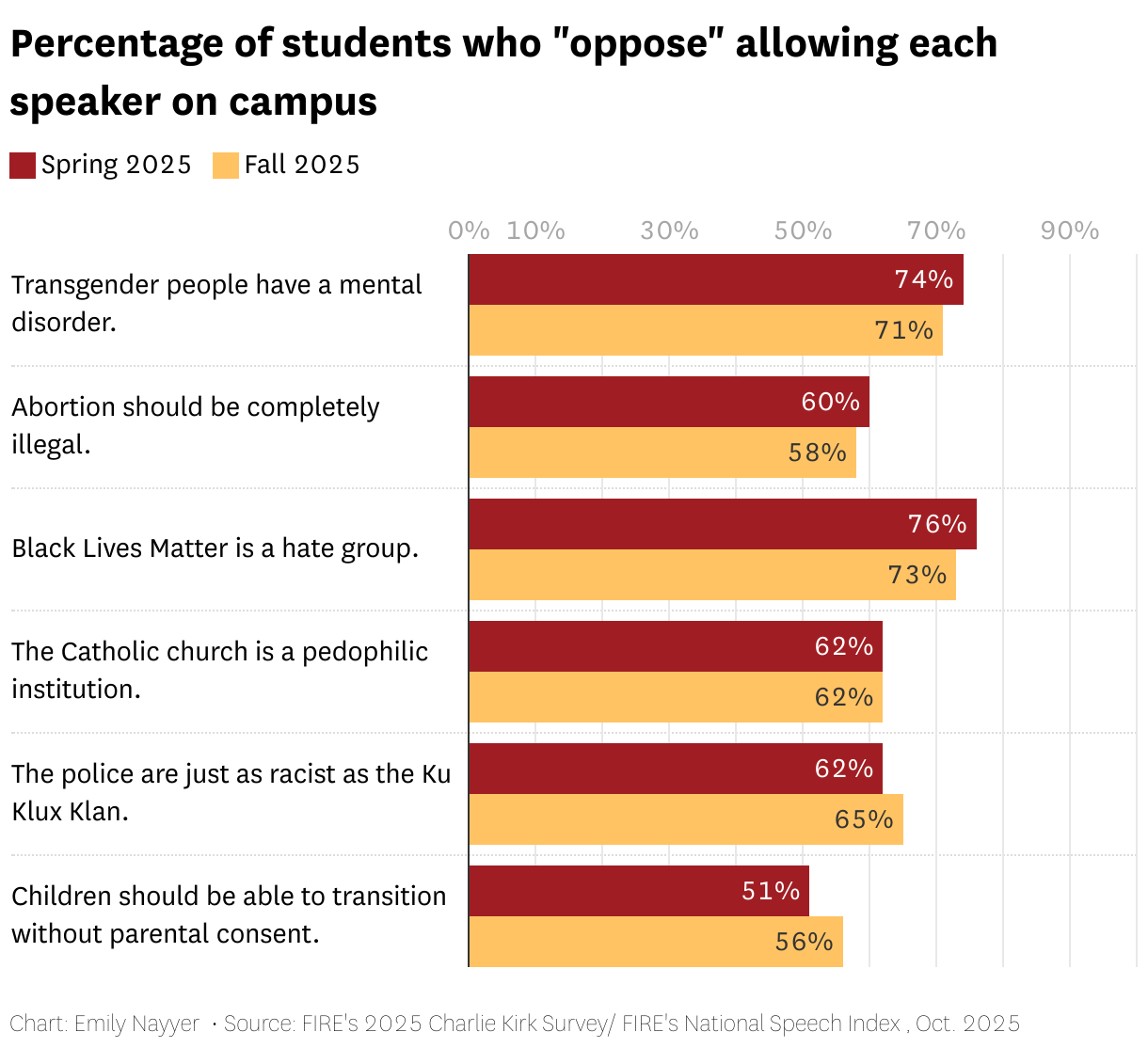
Attitudes toward controversial speakers among non-UVU students remained largely stable in the wake of the Kirk assassination. Across five of the six speaker scenarios included in both the spring 2025 College Free Speech Rankings survey and the fall post-assassination survey, there was no significant change in overall tolerance.
The only exception was the speaker who previously said, 鈥淐hildren should be able to transition without parental consent.鈥� Opposition to this speaker increased slightly, from 51% in the spring to 55% in the fall.
Among moderate and conservative students, opposition to controversial speakers generally declined, signaling increased tolerance, with a notable exception: among moderates, opposition to the speaker who said 鈥淏lack Lives Matter is a hate group鈥� rose from 68% to 73%. Among conservatives, opposition to the same speaker increased from 51% to 60%.
Opposition among liberal students, on the other hand, either held steady or increased for all of the controversial speakers compared to the spring. In particular, opposition to allowing someone who previously said that 鈥淭he police are just as racist as the Ku Klux Klan鈥� and 鈥淐hildren should be allowed to transition without parental consent" increased considerably.
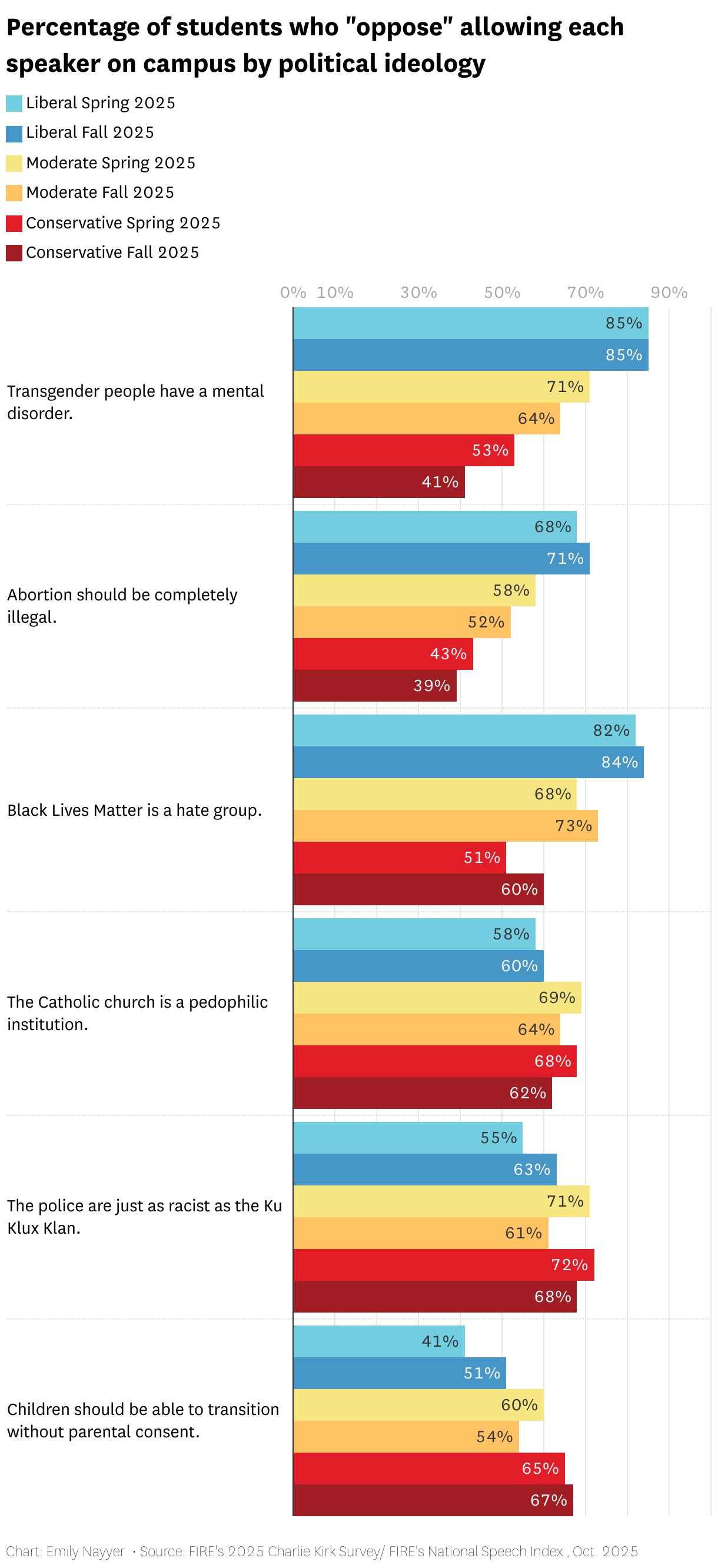
This suggests that moderate and conservative students may be pulling back from speaker bans, while liberal students are becoming more inclined to exclude speakers whose views they find harmful or offensive. The ideological gap in speaker tolerance appears to be widening, not narrowing, after a high-profile political killing.
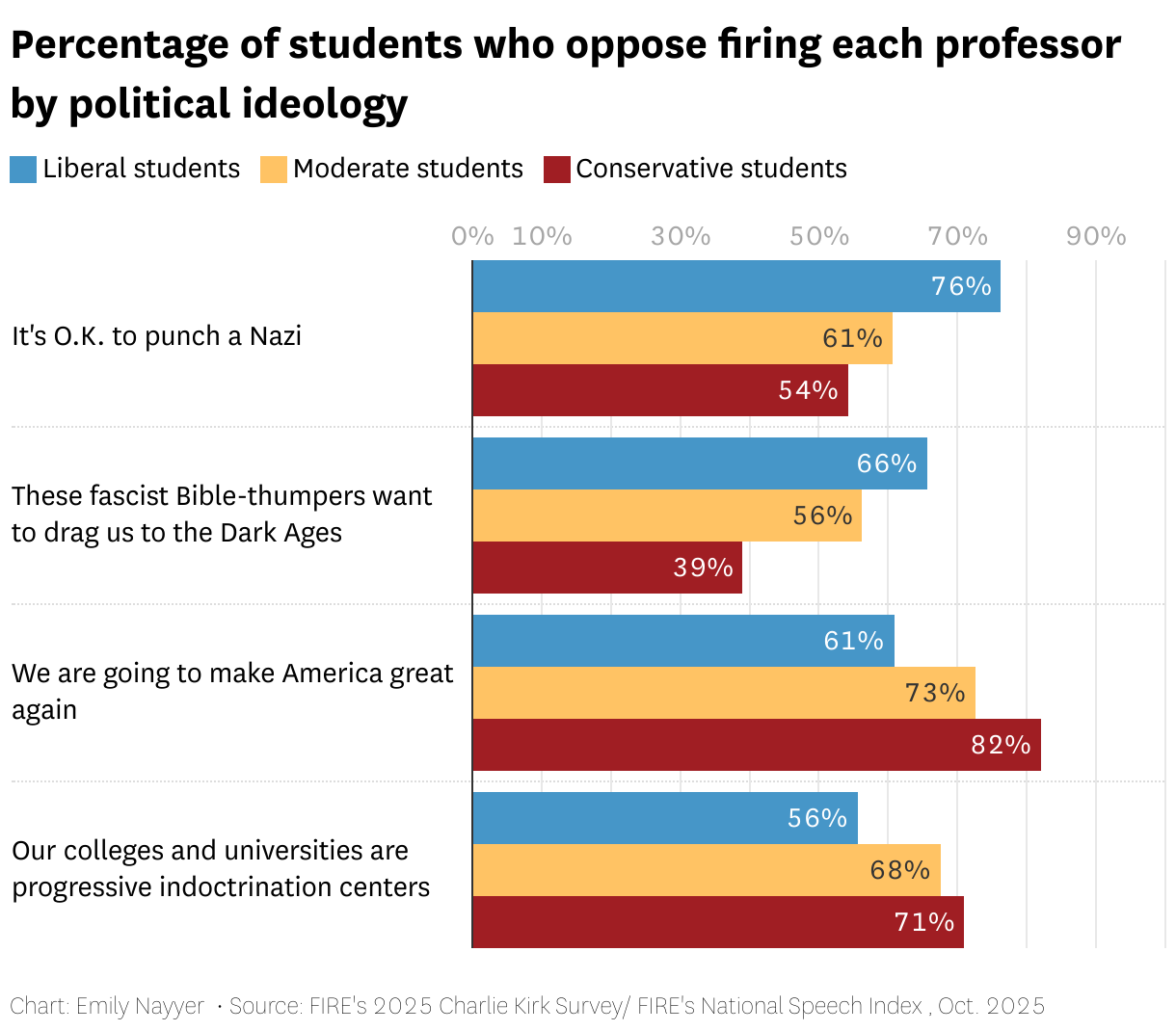
One encouraging finding is that students nationwide, and at Utah Valley University, showed greater tolerance for controversial statements made by professors after the Kirk assassination than for allowing controversial speakers on campus. When presented with a series of provocative hypothetical posts made by professors on social media, most students said the professors should not be fired, regardless of the political slant of the comment. This held true for statements such as 鈥淚t鈥檚 okay to punch a Nazi鈥� and 鈥淲e are going to make America great again.鈥� Although tolerance dropped somewhat for more inflammatory or ideologically loaded statements, like calling religious conservatives 鈥渇ascist Bible-thumpers鈥� or referring to universities as 鈥減rogressive indoctrination centers,鈥� majorities still opposed termination.
This heightened tolerance among students for professors who made controversial statements about Kirk鈥檚 assassination is encouraging. At the same time, it mostly pales in comparison to the tolerance levels among the general public. 蜜桃直播鈥檚 October National Speech Index posed these same questions to a sample of 1,000 Americans from Oct. 20 to 28.[20] A clear majority opposed firing all four professors, with the percentages opposing firing ranging from 55% (鈥淚t鈥檚 O.K. to punch a Nazi.鈥�) to 86% (鈥淲e鈥檙e going to make America great again.鈥�).
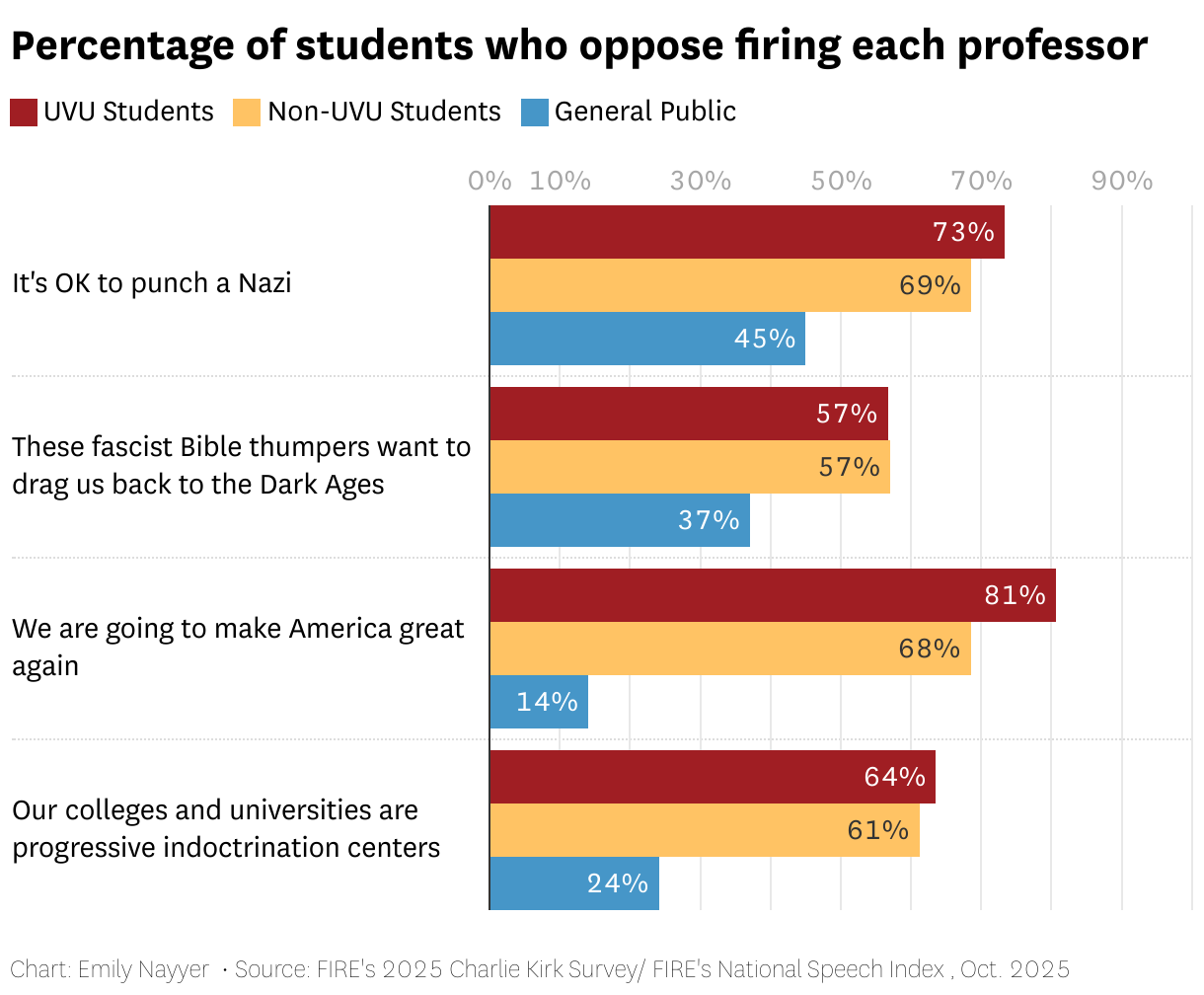
Clear ideological differences are also evident in how students responded to these hypothetical professor statements. Nationwide, liberal students were generally the most opposed to firing, especially when the comment aligned with left-leaning views. For example, 76% of liberals said a professor who posted 鈥淚t鈥檚 O.K. to punch a Nazi鈥� should not be fired, compared to 61% of moderates and 54% of conservatives. Conversely, conservative students were most likely to oppose firing when the controversial comment aligned with their views. For instance, 82% of conservatives said a professor should not be fired for posting 鈥淲e are going to make America great again,鈥� compared to 73% of moderates and 61% of liberals.
Liberal students, however, opposed firing all four professors they were asked about. A majority of conservative students (61%), in contrast, say a professor who posted 鈥淭hese fascist Bible-thumpers want to drag us back to the Dark Ages鈥� following Kirk鈥檚 death should be fired.
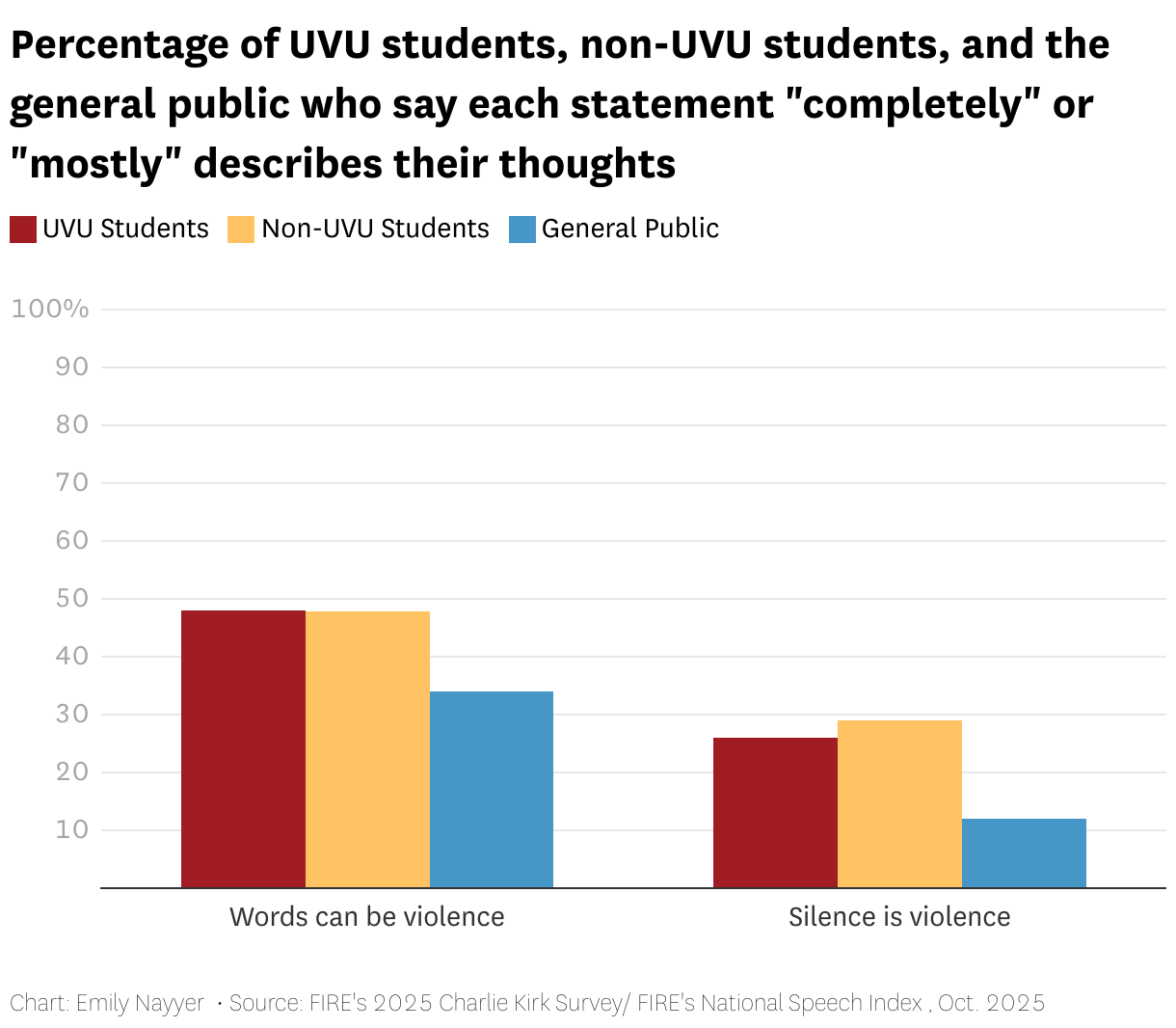
Finally, to better understand how students interpret the relationship between speech, silence, and violence, the survey included a series of attitudinal questions asking how well certain statements described their thinking. These included phrases like 鈥淲ords can be violence鈥� and 鈥淪ilence is violence,鈥� as well as assessments of whether political violence is a problem among progressives, conservatives, or all political groups.
Among students nationwide nearly half of students (48%) say that the phrase 鈥淲ords can be violence鈥� either 鈥渃ompletely鈥� or 鈥渕ostly鈥� describes their thoughts. This is also the case among students at UVU (46% say this). Fewer students nationwide and at UVU (29% and 26%, respectively) endorsed the idea that 鈥淪ilence is violence,鈥� though this belief still has support among at least a quarter of students.
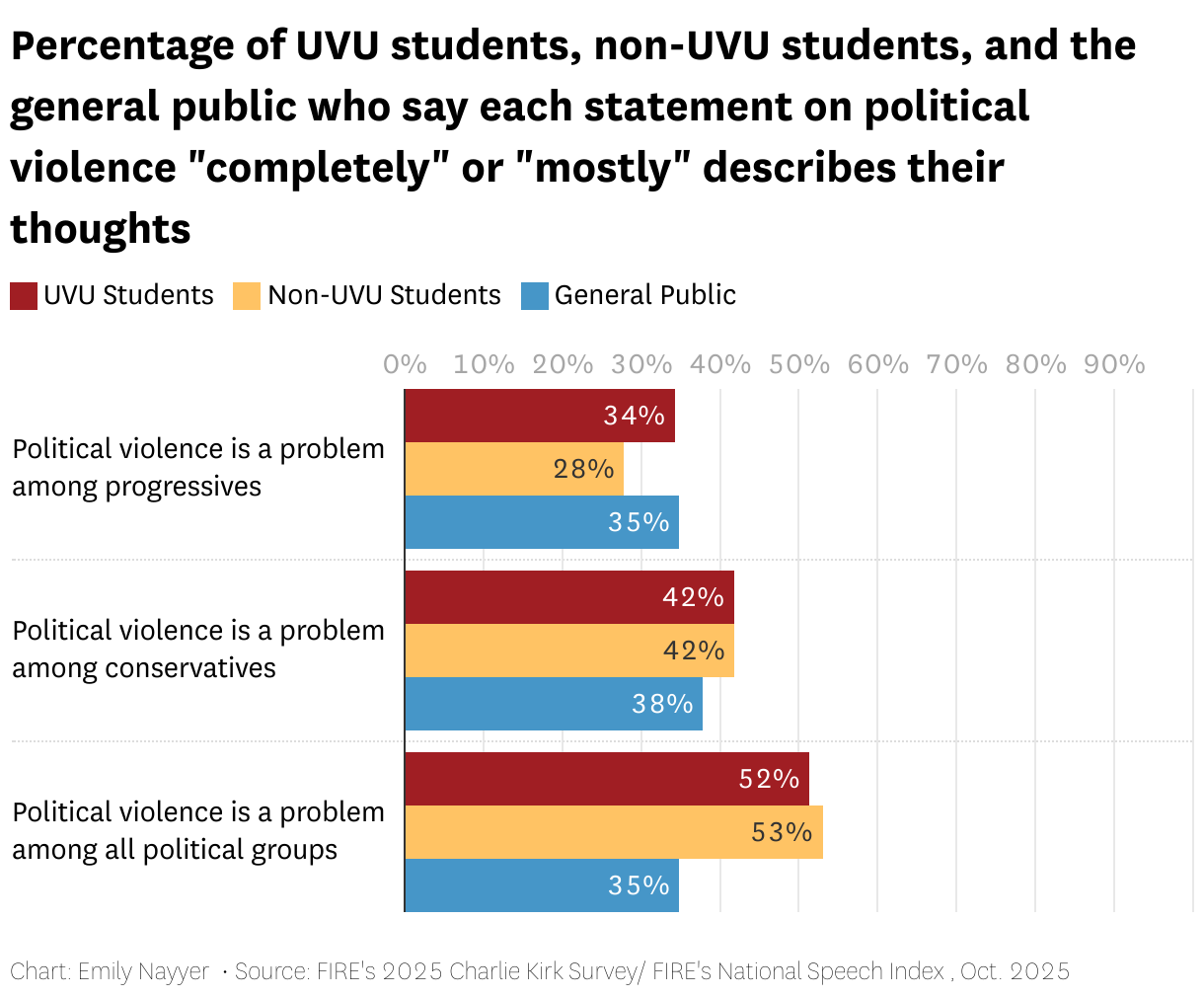
When asked about political violence, most students saw it as a problem across the ideological spectrum. But differences did emerge between UVU students and those on other campuses. UVU students were more likely than their peers elsewhere to say political violence is a problem among progressives (34% at UVU, 28% nationwide), while students across all campuses were equally likely to say it's a problem among conservatives (42% nationwide and at UVU). A majority of students in both samples agreed that political violence is a problem across all political groups (53% nationwide, 52% at UVU).
Compared to the general public, students were significantly more likely to endorse the idea that 鈥淲ords can be violence鈥� and that political violence is widespread. Among the broader population, just over a third said, 鈥淲ords can be violence鈥� describes their thinking, far below the nearly half of college students who agreed. Students were also more likely than the general public to say political violence is a bipartisan problem, suggesting a broader sense of threat but perhaps also a more universal framing of the issue.[21]
Conclusions
The assassination of Charlie Kirk was not just a flashpoint, it was a test: a test of campus norms, institutional resilience, and the boundaries of expression in a time of deep national division. This survey offers a first look at how students across the country, and particularly at Utah Valley University, are responding to that test.
The results paint a complex picture. In many ways, the assassination appears to have deepened existing fractures. Students report feeling less comfortable expressing themselves, especially those who are politically conservative or attend UVU. Support for aggressive protest tactics has declined among moderates and conservatives, while liberal students largely maintained or even increased their tolerance for such actions. Attitudes toward controversial speakers have become more polarized, with ideological differences widening. And while most students opposed firing professors on their campus for making provocative social media posts following Kirk鈥檚 death, their judgments were often shaped by their own political views.
At the same time, there are signs of resilience. Faculty on campus are given more leeway than guest speakers. And despite the trauma of the event, UVU students report more trust in their university to protect speech rights than students at other institutions.
Still, the broader takeaway is clear: The assassination has had a chilling effect 鈥� not just at UVU, but across the country. Students say they are pulling back, are speaking less, and are less comfortable attending events. This is not being done in response to policy, but because of fear. If campus leaders, faculty, and policymakers want to protect academic freedom and open inquiry, they must reckon with that fear, and work to rebuild a culture of expression that can withstand not just controversy, but crisis.
Methodology
FIRE commissioned College Pulse to conduct a nationwide survey of college undergraduates, including an oversample of students at Utah Valley University. The sample included 2,028 undergraduates, including 204 from UVU. The survey was fielded between Oct. 3 and Oct. 31, 2025. The survey鈥檚 margin of error is +/- 2.2%.
The National Speech Index is a quarterly poll designed by 蜜桃直播 and conducted by the Dartmouth Polarization Research Lab and YouGov to capture Americans鈥� views on freedom of speech and the First Amendment, and to track how Americans鈥� views change over time. The October 2025 National Speech Index includes a sample of 1,000 Americans and was conducted from Oct. 20 to 28. The survey鈥檚 margin of error is +/- 3.0%.
Poststratification weights were applied to all data reported.
Survey questions and topline results
Click here to view full list of survey questions and topline results
Acknowledgments
Our gratitude goes to Sean Stevens for study and questionnaire design, data collection, data analysis, and authoring this report; and to Nathan Honeycutt for support with study and questionnaire design. We would additionally like to thank Chapin Lenthal-Cleary for data checking and validation; Emily Nayyer for data visualization; Cantelon Design for designing the report; Jordan Howell for designing the online version of the report; and Logan Dougherty, Angela C. Erickson, Ryne Weiss, Alex Griswold, and David Volodzko for editing support.
Greg Lukianoff
President and CEO, 蜜桃直播
Citation
Stevens, S.T. (2025). After the earthquake: How the assassination of Charlie Kirk is reshaping campus speech nationwide. The 蜜桃直播. Available online: /research-learn/how-assassination-charlie-kirk-reshaping-campus-speech-nationwide
About us
The 蜜桃直播 (蜜桃直播) is a nonpartisan, nonprofit organization dedicated to defending and sustaining the individual rights of all Americans to free speech and free thought. These rights include freedom of speech, freedom of association, due process, legal equality, religious liberty, and sanctity of conscience 鈥� the most essential qualities of liberty. 蜜桃直播 also recognizes that colleges and universities play a vital role in preserving free thought within a free society. To this end, we place a special emphasis on defending these rights of students and faculty members on our nation鈥檚 campuses.
For more information, visit or @thefireorg on X.
Notes
[1] Associated Press (Sept. 10, 2025). Conservative activist Charlie Kirk assassinated at Utah university. Available online: .
[2] Lukianoff, G. (Nov. 7, 2025). Speaking at the site of a murder: My speech at Utah Valley University 鈥� and why America must not become like everybody else. Available online: .
[3] Bauder, D. & Swenson, A. (Sept. 15, 2025). Matthew Dowd鈥檚 firing begins flood of people facing consequences for comments on Charlie Kirk鈥檚 death. Available online: .
[4] Humbles, A. (Sept. 11, 2025). Cumberland University cancels Matthew Dowd lecture after Charlie Kirk comments. Available online: .
[5] Lindner, J. (Oct. 15, 2025). KSU student arrested after protesting Charlie Kirk memorial. Available online: .
[6] Stevens, S. & Lenthall-Cleary, C. (Sept. 30, 2025). The government is now the leading threat to faculty expression: 77% of all sanction efforts involve government actors. Available online: .
[7] The number of attempts to sanction individual students and student groups was calculated on Nov. 19, 2025. See: /research-learn/students-under-fire?orderdir=desc&orderby=year.
[8] Wen, Leana S. (Oct. 21, 2025). Utah Valley University faced a choice after Charlie Kirk鈥檚 killing: The school鈥檚 president sought to care for her community after the shocking assassination. Available online: .
[9] Stevens, S.T. (2025). 2026 College Free Speech Rankings: What Is the State of Free Speech on America鈥檚 College Campuses? The 蜜桃直播. Available online: /research-learn/2026-college-free-speech-rankings.
[10] Wen (Oct. 21, 2025).
[11] Wen (Oct. 21, 2025).
[12] 蜜桃直播 (Nov. 13, 2025). NEW HIGH: 3/4 of Americans say free speech is headed in the wrong direction. Available online: /news/new-high-34-americans-say-free-speech-headed-wrong-direction.
[13] Stevens, S.T. (2025).
[14] 蜜桃直播鈥檚 2026 College Free Speech Rankings: Utah Valley University. Available online: .
[15] Stevens, S.T. (2025).
[16] 蜜桃直播 (Nov. 13, 2025).
[17] Stevens, S.T. (2025).
[18] Stevens, S.T. (2025).
[19] 蜜桃直播鈥檚 2026 College Free Speech Rankings: Utah Valley University. Available online: .
[20] 蜜桃直播 (Nov. 13, 2025).
[21] 蜜桃直播 (Nov. 13, 2025).